Even Santa has to keep an eye on the workshop expenses!
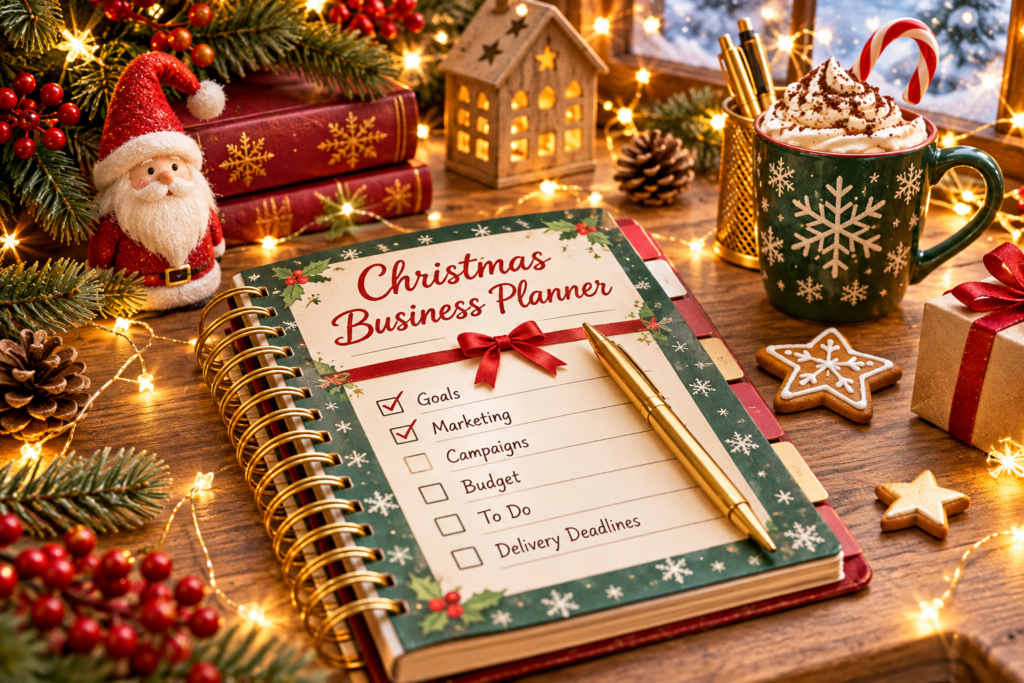
The Christmas lights are twinkling, the festive campaigns are taking shape, and your notebook is filling up with wonderful marketing ideas.
A little advertising here. Some beautiful product photography there. Perhaps a new email marketing tool, a Christmas giveaway and a few festive packaging extras.
Before you know it, your Christmas marketing budget has disappeared faster than the last mince pie!
Sound familiar?
Christmas can be one of the most exciting times of the year for small businesses, but it’s also a season when expenses can quickly add up.
The good news? You don’t need a sleigh full of money to create a thoughtful Christmas marketing campaign.
You need a realistic budget, clear priorities and a way to keep track of your spending.
So grab your calculator, pour yourself a hot chocolate and let’s get those Christmas finances organised!
1. Start With Your Christmas Business Goals ⭐
Before deciding how much money to spend, think about what you want your Christmas campaign to achieve.
Are you hoping to increase sales? Attract new customers? Launch a festive product collection? Encourage previous customers to return?
Your goals will influence how you allocate your budget.
For example, a business launching a new product might spend more on photography and advertising, while an established retailer might concentrate on email marketing and customer retention.
Try writing down one main goal.
Example: Generate £3,000 in Christmas sales while keeping marketing expenditure below £300.
That gives you a clear target to work towards.
However, remember that £3,000 in sales isn’t £3,000 in profit. You’ll still need to account for product costs and other business expenses.
Christmas Coach Tip: Choose a budget that your business can afford even if the campaign doesn’t achieve its sales target.
2. Work Out What You Can Afford 💷
Here’s where we open Santa’s accounting book!
Your Christmas marketing budget should be based on your actual financial circumstances, not what competitors appear to be spending.
Start by reviewing:
- Available business cash.
- Expected revenue.
- Product or service costs.
- Existing operating expenses.
- Seasonal stock or production requirements.
- Any outstanding financial commitments.
Avoid spending money that you need for essential business costs.
You might decide to fund your campaign from savings already allocated to marketing, or from a manageable portion of your expected trading income.
There isn’t one universal marketing budget percentage that suits every small business.
A new business, an established shop and a freelance service provider may all have very different needs.
Christmas Coach Tip: If your budget is limited, focus on one or two marketing activities rather than spreading a small amount across too many channels.
3. Make Your Christmas Marketing Shopping List 🎁
Once you know what you can afford, list everything your campaign might require.
Typical Christmas marketing expenses include:
Advertising
Paid social media campaigns, search advertisements or other promotional placements.
Photography and Design
Product photographs, promotional graphics, editing software or design services.
Email Marketing
Email platform subscriptions, templates or campaign tools.
Promotional Materials
Printed leaflets, postcards, banners or other marketing materials.
Samples and Giveaways
Products used for photography, demonstrations, customer incentives or promotional activities.
Website Updates
Seasonal landing pages, website improvements or relevant technical support.
Contingency
A small reserve for unexpected costs.
You may not need every category.
For example, a digital product seller might have no packaging expenses, while a physical retailer may need to account for additional display materials.
Christmas Coach Tip: Separate genuine marketing costs from stock, production and fulfilment costs. You’ll need to consider both when calculating profitability, but keeping them separate makes your marketing budget easier to understand.
4. Build Your First Christmas Marketing Budget 📊
Let’s imagine a small online business has £300 available for its Christmas marketing campaign.
Here’s one way it could divide that money.
| Marketing Expense | Planned Budget |
|---|---|
| Paid advertising | £120 |
| Photography and design | £40 |
| Email marketing tools | £20 |
| Promotional materials | £30 |
| Samples and giveaways | £30 |
| Contingency | £60 |
| Total | £300 |
This is an illustrative budget, not a recommended amount for every business.
Notice that we’ve included £60 for unexpected expenses.
That reserve can help if an advertising test needs adjusting or a necessary marketing cost turns out to be higher than expected.
You don’t have to spend your entire budget just because you’ve allocated it.
Money left unspent is not a marketing failure!
5. Prioritise Your Christmas Marketing Activities 🎄
Imagine you have £100 to spend.
You could divide it between five different advertising platforms, purchase several subscriptions and print a stack of promotional leaflets.
But would that actually help your business?
Probably not unless those activities are closely connected to your customers.
Instead, ask yourself:
Where are my customers most likely to discover and purchase my products?
If most of your customers already come from your email list, improving your Christmas email campaign may be more useful than experimenting with an unfamiliar advertising platform.
If your products are highly visual, strong product photography and relevant social content may be priorities.
If customers discover your business through search engines, useful Christmas articles and well-organised product pages may be worthwhile investments.
Christmas Coach Tip: Put your budget towards activities with a clear purpose and a realistic way to measure results.
6. Keep Track of Planned Versus Actual Spending ✏️
A budget is only useful if you keep checking it.
You might plan to spend £50 on advertising but end up spending £80.
Or perhaps you budgeted £40 for photography and managed to create the images yourself.
Record the difference.
Here’s an example.
| Expense | Planned | Actual | Difference |
|---|---|---|---|
| Advertising | £120 | £140 | £20 over |
| Photography | £40 | £20 | £20 under |
| Email tools | £20 | £20 | On budget |
| Promotional materials | £30 | £25 | £5 under |
| Samples | £30 | £35 | £5 over |
| Contingency | £60 | £0 | £60 unused |
| Total | £300 | £240 | £60 under |
In this example, the business spent £240 of its £300 budget.
That’s useful information.
You can now decide whether to keep the remaining money, reserve it for another campaign or use a portion for an activity that has demonstrated promising results.
Christmas Coach Tip: Review your spending at least once a week during your active campaign.
7. Understand Whether Your Christmas Marketing Is Working ⭐
Let’s talk about one of the most important parts of your Christmas budget: results.
It’s exciting to see orders coming in, but sales figures alone don’t tell the whole story.
Suppose you spend £100 on advertising and generate £400 in sales that can reasonably be attributed to those advertisements.
Your return on ad spend, or ROAS, is:
£400 ÷ £100 = 4
That means you generated £4 in attributed revenue for every £1 spent on advertising.
Sounds wonderful!
But there’s an important catch.
ROAS measures revenue, not profit.
You still need to consider product costs, delivery subsidies, transaction fees and other relevant expenses.
A Simple Profitability Example
Imagine those £400 in sales involve:
- £160 in product costs.
- £40 in fulfilment and transaction costs.
- £100 in advertising.
That leaves £100 before other overheads, taxes and any additional costs.
So although the advertising generated £400 in revenue, the remaining contribution is much smaller.
Christmas Coach Tip: Don’t judge a campaign solely by clicks, views or revenue. Look at how much money is left after the costs associated with generating those sales.
8. Avoid These Common Christmas Budget Mistakes 🚫
Even the most organised Christmas workshop can run into financial trouble.
Here are a few mistakes worth avoiding.
Spending Before Setting Goals
Buying advertising without knowing what you want to achieve makes it difficult to judge success.
Copying Competitors
A large retailer’s Christmas advertising budget may be completely unsuitable for a small independent business.
Forgetting Hidden Costs
Payment processing, software subscriptions, delivery subsidies and production expenses can all affect profitability.
Offering Discounts Without Checking Margins
A generous discount may attract customers but leave very little profit.
Calculate the financial impact before launching an offer.
Ignoring Campaign Results
If an advertisement isn’t producing useful results, don’t keep spending simply because it was part of your original plan.
Spending Every Penny
Keeping some flexibility in your budget can help you manage unexpected expenses.
9. What If You Have Almost No Christmas Marketing Budget? ❤️
Perhaps your business is new, or money is particularly tight this year.
That doesn’t mean you have to abandon Christmas marketing.
There are plenty of activities that don’t require substantial advertising expenditure.
You could:
- Write helpful Christmas gift guides.
- Improve your existing product descriptions.
- Create festive social media content.
- Send relevant emails to existing subscribers.
- Collaborate with complementary small businesses.
- Share behind-the-scenes stories.
- Create a simple Christmas landing page.
- Encourage genuine customer reviews.
These activities still require time and effort, so they’re not entirely cost-free.
But they can help you make use of resources you already have.
Christmas Coach Tip: Start with your existing audience and strongest products before investing in unfamiliar marketing channels.
10. Review Your Budget After Christmas 🎅
Once the festive rush has finished, it’s time for a little Christmas accounting.
Before packing away your marketing materials, review your campaign.
Ask yourself:
- How much did I plan to spend?
- How much did I actually spend?
- Which activities generated measurable results?
- Which campaigns produced profitable sales?
- Were any expenses unnecessary?
- What would I budget differently next year?
Keep these notes with your Christmas marketing calendar.
Next year, you won’t have to start from scratch.
You’ll have real information to guide your decisions.
Your Christmas Marketing Budget Doesn’t Need to Be Complicated 🎄
A good Christmas marketing budget isn’t about spending the most money.
It’s about making thoughtful decisions with the resources you have.
Set clear goals, understand your costs, prioritise the activities that matter and review your results regularly.
And remember, a small business with a sensible £100 marketing budget can be better prepared than a business spending £1,000 without a clear plan.
Here at Christmas Coach, we’re filling our festive workshop with practical business resources to help you organise your campaigns, plan your promotions and keep your Christmas spending under control.
So grab your calculator, sharpen your pencil and give your Christmas marketing budget a little festive attention.
Because even Santa knows that a well-managed workshop makes for a merrier Christmas!
Merry Christmas and happy budgeting!
The Christmas Coach Workshop 🎄❤️